
The Great Paradox: Why More Connection Leads to Less Community

The Great Paradox: Why More Connection Leads to Less Community
We were promised a global village. At the dawn of the social media era, the narrative was one of radical optimism: technology would bridge the gaps of geography, culture, and language. We were told that by being “connected” 24/7, we would finally eradicate the age-old human ache of loneliness. Yet, two decades into this grand experiment, the data tells a different story. We are living through what health officials call a “loneliness epidemic,” where despite having thousands of digital “friends,” the average person reports having fewer close confidants than at any point in history.
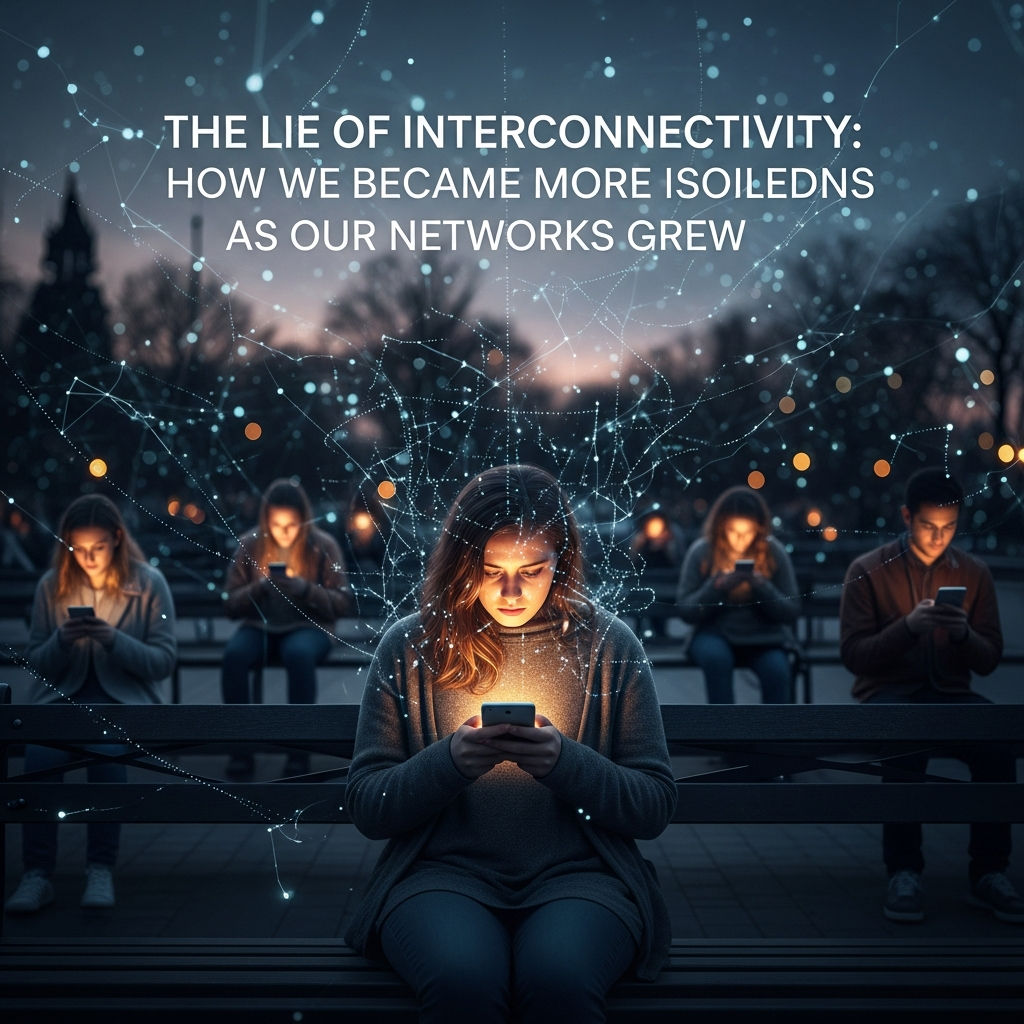
The “Lie of Interconnectivity” is the false belief that digital accessibility is synonymous with emotional intimacy. As our networks grew, our social muscles atrophied. We traded the messy, demanding, and deeply rewarding nature of physical presence for the convenient, curated, and ultimately hollow experience of digital interaction. To understand how we became more isolated as our networks grew, we must look at the psychological and structural shifts that turned our hyper-connected world into a digital desert.
The Science Behind Digital Loneliness
Human connection is not just a psychological preference; it is a biological necessity. For millennia, human survival depended on tight-knit tribal groups. Consequently, our brains are hardwired to respond to specific social cues—eye contact, physical touch, and the subtle nuances of tone and body language. These interactions trigger the release of oxytocin, often called the “bonding hormone.”
Digital communication, however, strips these elements away. When we interact through a screen, we lose up to 90% of the non-verbal data that our brains use to establish trust and empathy. The result is a phenomenon known as “social snacking.” Much like junk food, digital interactions provide a temporary burst of “likes” and “comments” that mimic social nourishment but leave our emotional systems starving for substance. We are constantly “snacking” on notifications, yet we remain chronically malnourished in our relationships.
The Loss of Non-Verbal Cues
In a face-to-face conversation, the brain is working overtime to process micro-expressions and postural shifts. In the digital realm, we rely on emojis and text. This leads to several systemic issues in our relationships:
- Misinterpretation: Without tone, a neutral text can be perceived as hostile, leading to unnecessary conflict.
- Emotional Flattening: We lose the ability to truly “feel” with others, as the screen acts as a barrier to empathy.
- Performative Interaction: We stop communicating to be understood and start communicating to be seen, focusing on how our “post” will be received rather than what we are sharing.
The “Weak Ties” Trap: Quantity Over Quality
Sociologist Mark Granovetter famously wrote about the “strength of weak ties”—the idea that casual acquaintances are useful for networking and information. Social media is the ultimate engine for generating weak ties. We are now connected to high school classmates we haven’t spoken to in twenty years and colleagues from three jobs ago.
The problem arises when these weak ties begin to crowd out our “strong ties”—the deep, intimate relationships that sustain us during crises. Because we spend so much emotional energy maintaining a broad network of superficial connections, we have less time and energy for the few people who actually matter. We have traded the depth of a few for the breadth of many, and in doing so, we have sacrificed the very foundation of social support.
The Comparison Trap and the Death of Authenticity
One of the primary drivers of isolation in the digital age is the “Comparison Trap.” Before the internet, you might have compared your life to your neighbor’s. Today, you are comparing your “behind-the-scenes” reality to the “highlight reels” of thousands of people, including celebrities and influencers. This creates a perpetual sense of inadequacy.
When we feel inadequate, we tend to withdraw. We feel that our “real” lives—complete with dirty dishes, career setbacks, and mental health struggles—are not fit for public consumption. This leads to a dual-life existence:
- The Digital Persona: A curated, polished version of ourselves that we present to the world to gain validation.
- The Private Self: The version of ourselves that feels increasingly isolated because no one seems to know the “real” us.
This gap between the persona and the self is where loneliness thrives. Authenticity is the prerequisite for true connection; without it, we are merely two avatars interacting while the humans behind them remain invisible.
The Algorithm of Isolation
We must also acknowledge that the platforms we use are not neutral. They are designed by “attention engineers” whose goal is to keep us scrolling for as long as possible. Loneliness, it turns out, is incredibly profitable. When we feel lonely or insecure, we are more likely to seek out dopamine hits through social validation or engage in impulsive consumption.
Algorithms prioritize content that triggers high emotional responses—usually outrage or envy. This pushes us into echo chambers where we only interact with people who think exactly like us. Paradoxically, this “tribalism” makes us feel more alone. We become afraid of dissent, wary of nuance, and increasingly disconnected from the diverse tapestry of human experience. We are more connected to “content” than we are to people.
Breaking the Cycle: How to Reclaim Real Connection
The solution to the lie of interconnectivity is not to abandon technology altogether, but to change our relationship with it. We must shift from passive consumption to intentional connection. Reclaiming our sense of community requires us to prioritize “high-friction” interactions over “low-friction” digital noise.
Strategies for Reconnection
- The Phone-First Rule: If you have something important to say, call or meet in person. Voice and video provide the emotional context that text lacks.
- Digital Minimalism: Prune your networks. Unfollow accounts that trigger envy and focus your energy on a “circle of five” close friends.
- Embrace Boredom: Loneliness often stems from a fear of being alone with our thoughts. By allowing ourselves to be bored without reaching for a phone, we build the internal resilience needed for healthy external relationships.
- Shared Physical Activities: Join a club, a sports team, or a volunteer group. Physical presence in a shared pursuit is the fastest way to build oxytocin and genuine trust.
Conclusion: The Path Back to Each Other
The lie of interconnectivity is that we can be “together” while remaining apart. We have built a world where we are constantly reachable but rarely reachable in a meaningful way. We are surrounded by digital ghosts of people, interacting with data points rather than souls.
To end the loneliness epidemic, we must recognize that a “network” is not a “community.” A network is a series of nodes; a community is a web of support. As our networks continue to grow, we must be more vigilant than ever to ensure that our hearts don’t shrink in the process. The path back to each other begins with putting down the screen, looking into the eyes of the person across from us, and embracing the beautiful, un-curated mess of being truly known.