
The Cult of Clean Code: When Best Practices Become Worst Enemies
“`html
The Cult of Clean Code: When Best Practices Become Worst Enemies
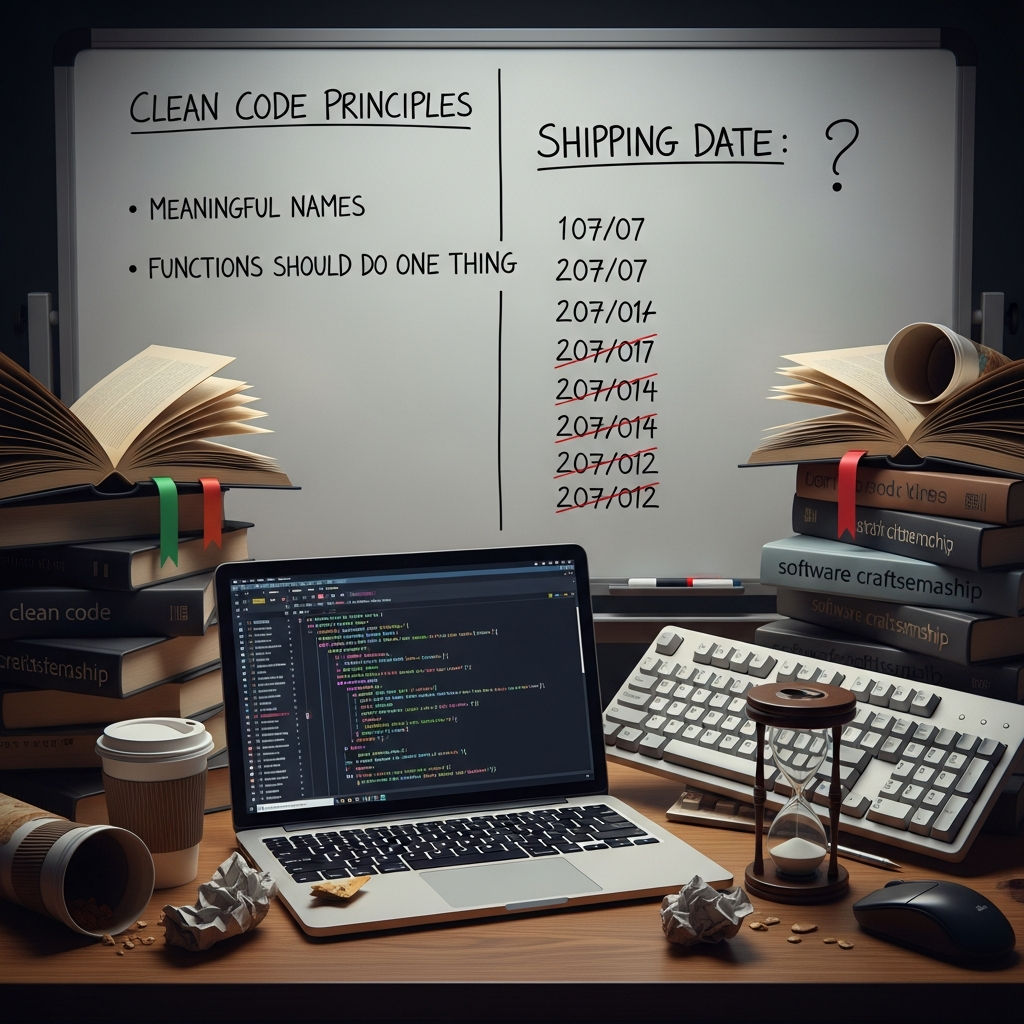
In the modern software development landscape, “Clean Code” has reached a status nearing religious dogma. Developers spend hours debating the placement of a semicolon, the purity of a design pattern, or the architectural sanctity of a microservice. While writing maintainable code is undeniably important, there is a dark side to this obsession that few want to admit: Clean code is often a sophisticated form of procrastination.
For many developers, the quest for the “perfect” codebase is a psychological shield. It is a way to stay within the comfortable confines of an IDE while avoiding the messy, terrifying reality of shipping a product to real users. If you are constantly refactoring but never releasing, you aren’t being a craftsman; you are hiding.
The Comfort of the Refactor
Refactoring feels like progress. It generates green checkmarks in your test suite and gives you a dopamine hit of “order” in a chaotic world. However, from a business perspective, refactoring code that already works produces exactly zero immediate value. When a developer chooses to rewrite a working module because it “isn’t elegant enough” instead of pushing a new feature, they are often choosing the path of least resistance.
Shipping is hard. Shipping involves vulnerability. When you ship, you face the possibility that your idea is wrong, your UI is confusing, or your product-market fit is non-existent. Refactoring, on the other hand, is safe. The code can’t reject you. By focusing on “cleanliness,” developers can stay busy without ever having to face the judgment of the marketplace.
The “Architecture Astronaut” and the Cost of Delay
Joel Spolsky once coined the term “Architecture Astronauts” to describe people who get so high up in abstractions that they lose sight of the ground. These are the developers who spend three weeks building a generic, scalable notification framework for a product that doesn’t even have ten users yet.
This is the essence of procrastination through over-engineering. By focusing on “Clean Code” principles like SOLID, DRY, and YAGNI (ironically, often violating YAGNI in the process), developers delay the most critical part of the software lifecycle: the feedback loop. Every day spent perfecting an abstraction is a day lost in learning whether the feature should even exist.
The Myth of the “Maintainable” Failure
There is a persistent myth in the tech world that code must be perfectly clean from day one so that it can be “maintained” in the future. But here is the cold, hard truth: Code that doesn’t ship doesn’t need to be maintained.
- A “messy” MVP that launches in two weeks and gains 1,000 users is a success.
- A “pristine” codebase that takes six months to launch and finds zero users is a total loss.
- Technical debt is only a problem if you have a business successful enough to actually owe it.
Technical Debt as a Strategic Tool
In the world of finance, debt isn’t inherently evil; it is a tool used to leverage growth. Software development is no different. “Dirty” code is often just a high-interest loan that allows you to buy time. In the early stages of a project, speed is your only competitive advantage.
If you are obsessing over the “cleanliness” of your code before you have achieved product-market fit, you are mismanaging your resources. You are paying off a mortgage on a house that might be demolished next month. Procrastinators use clean code as an excuse to avoid the “debt” of shipping, not realizing that the biggest debt of all is a wasted opportunity.
The YAGNI Principle: You Ain’t Gonna Need It
Most “clean code” tactics involve preparing for future change. We create interfaces “just in case” we swap out the database. We write complex wrapper classes “just in case” the API changes. This is defensive coding born out of a fear of the unknown. Usually, the “future change” we prepare for never happens, or it happens in a way we didn’t expect, making our “clean” abstractions obsolete anyway.
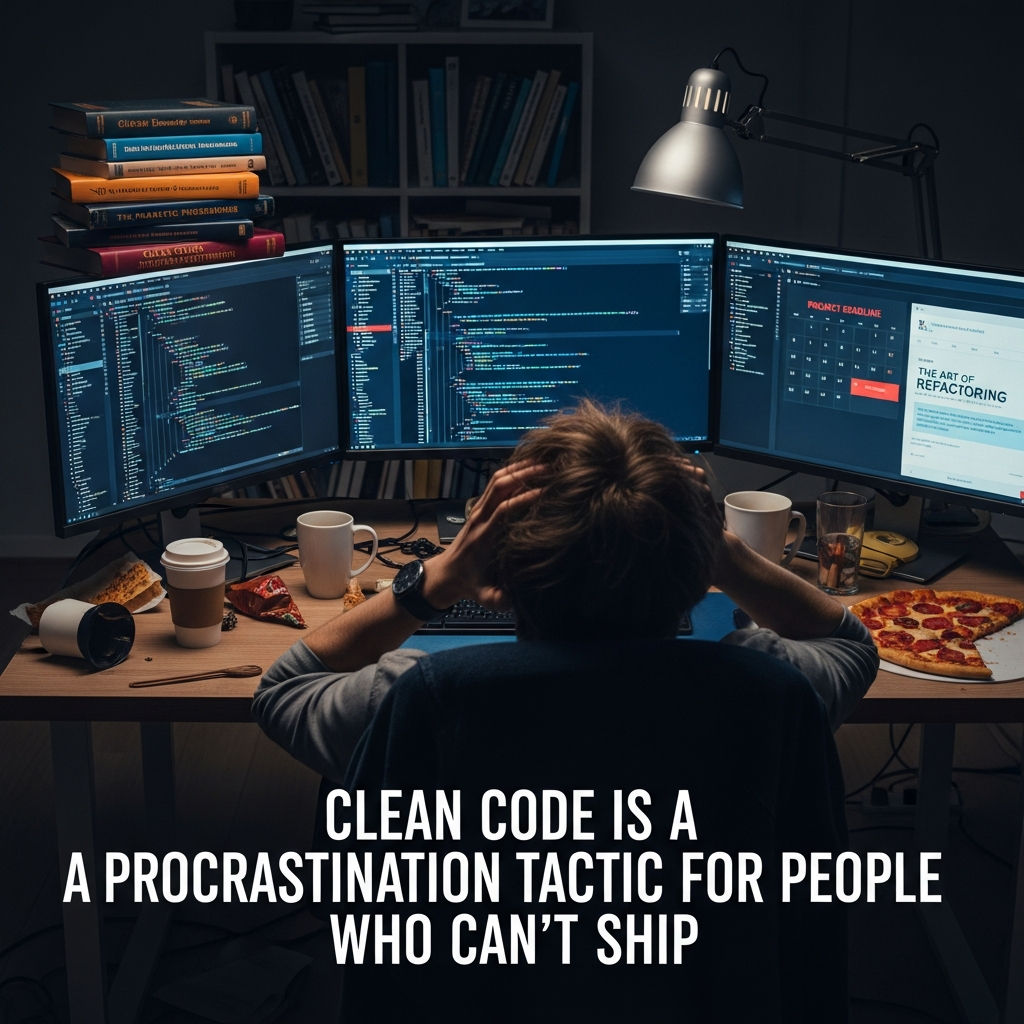
Procrastin-coding: Identifying the Symptoms
How do you know if you are using clean code as a procrastination tactic? Look for these red flags in your workflow:
- Infinite Refactoring: You’ve rewritten the same helper function three times this week without adding new functionality.
- Linter Wars: You spend more time configuring Prettier and ESLint than you do writing business logic.
- The “One More Pattern” Trap: You delay a PR because you just realized you could implement the Strategy Pattern instead of a simple switch statement.
- Documentation Overdrive: You write exhaustive TSDoc or JSDoc for internal functions that are likely to change by Tuesday.
If your “Definition of Done” keeps expanding to include more aesthetic polish and less functional utility, you are procrastin-coding.
The Startup Reality: Shipping is a Feature
In a competitive market, “shipped” is a better feature than “clean.” Users do not care if your backend is a spaghetti mess of Node.js or a perfectly decoupled Rust architecture. They care if the button works and if the app solves their problem.
The most successful developers are those who know when to be “hacky.” They understand that the goal of a developer is not to write code, but to deliver value. Code is merely the expensive, burdensome tool we use to deliver that value. The less code you can write to achieve a result, the better—regardless of how “clean” it looks on a GitHub gist.
Pragmatic Craftsmanship: The Middle Ground
This is not a call to write intentionally bad code. Total chaos eventually leads to a “Big Ball of Mud” that brings development to a screeching halt. The key is Pragmatic Craftsmanship. This means:
- Writing “clean enough” code to stay productive.
- Prioritizing readability over clever abstractions.
- Accepting that the first version of any feature will likely be discarded.
- Focusing on “Extensibility” only after you have “Proven Utility.”
Conclusion: Stop Polishing and Start Pushing
The next time you find yourself debating the nuances of a design pattern for a feature that hasn’t seen the light of day, ask yourself: “Am I doing this because it’s necessary, or because I’m afraid to ship?”
Clean code is a virtue, but perfectionism is a vice. Don’t let your desire for a beautiful codebase become the reason your project dies in obscurity. Perfectionism is just procrastination in a fancy suit. If you want to be a professional, you have to learn to embrace the mess, manage the debt, and—above all else—ship the product.
The world doesn’t pay you for the code you write; it pays you for the problems you solve.
“`