
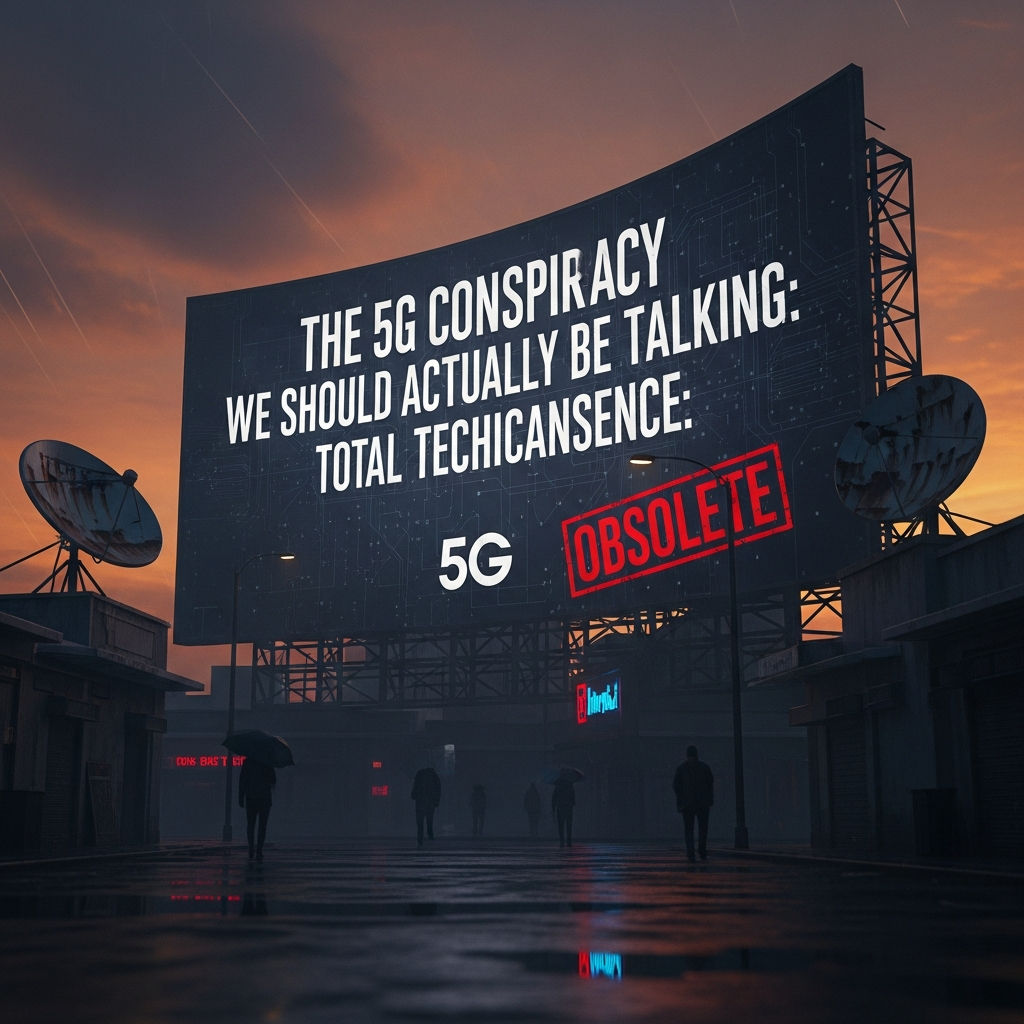
The 5G Conspiracy We Should Actually Be Talking About: Total Technical Obsolescence

“`html
The 5G Conspiracy We Should Actually Be Talking About: Total Technical Obsolescence
For years, the rollout of 5G technology has been shrouded in a fog of fringe theories. From claims of mind control to unfounded fears about non-ionizing radiation, the public discourse has been dominated by “conspiracies” that lack scientific backing. However, while we were busy debating the health effects of radio towers, a much more real, documented, and economically devastating “conspiracy” was unfolding right in our pockets.
This is the conspiracy of Total Technical Obsolescence. It isn’t a secret plot hatched in a basement; it is a transparent corporate strategy designed to ensure that every device you own has a predetermined expiration date, forced by the very infrastructure that promises to connect us. The transition to 5G represents the single greatest wave of forced hardware retirement in human history.
Moving Beyond the “Health Scare” Distraction
In the world of SEO and social media algorithms, fear sells. This is why 5G health myths went viral. But while these theories distracted the masses, the telecommunications industry began the process of “sunsetting” older networks. By dismantling 3G and reallocating 4G bandwidth to 5G, companies have effectively turned billions of dollars worth of functional technology into high-tech paperweights.
The real issue isn’t whether 5G signals are hurting us—it’s that the 5G ecosystem is designed to make everything you bought three years ago useless. This is planned obsolescence on a global, infrastructural scale.
What is Total Technical Obsolescence?
Technical obsolescence occurs when a product is no longer functional because the infrastructure required to support it has been withdrawn. Unlike “aesthetic obsolescence” (where you buy a new phone because it looks cooler), technical obsolescence gives you no choice. If the 3G or 4G bands your device relies on are throttled or shut down to make room for 5G, your device dies—regardless of how well you’ve maintained it.
- Network Sunsetting: Major carriers worldwide have already shut down 3G, leaving older medical devices, car GPS systems, and alarm monitors stranded.
- Spectrum Refarming: Carriers are taking the “lanes” on the digital highway used by older phones and giving them to 5G devices, leading to dropped calls and slow data for older models.
- Hardware Incompatibility: 5G requires specific antennas and modems that cannot be added via a software update. If you don’t have the chip, you don’t have the speed.
The Forced Hardware Upgrade Cycle
The 5G transition is a masterclass in manufactured demand. For the average consumer, the jump from 4G LTE to 5G isn’t as revolutionary as the jump from dial-up to broadband. For most tasks—checking email, streaming HD video, or scrolling social media—4G is more than sufficient. Yet, the industry marketing machine has framed 5G as a necessity.
By aggressively marketing 5G, manufacturers like Apple and Samsung have successfully shortened the smartphone upgrade cycle. When carriers offer “free” 5G phones with new contracts, they aren’t being generous. They are migrating users to a new ecosystem where data is more expensive and devices are harder to repair.
The Environmental Toll: The E-Waste Crisis
If we want to talk about a real “5G crime,” we should look at the planet. The push for total technical obsolescence has created an unprecedented environmental disaster. Every time a network generation shifts, hundreds of millions of functional devices are discarded.
Smartphone manufacturing is an incredibly resource-intensive process. It requires the mining of rare earth metals like cobalt, lithium, and neodymium—often in areas with poor human rights records. When 5G renders a 4G phone “obsolete,” it isn’t just a financial loss; it is a waste of the energy and materials used to create that device.
Why the 5G “Cloud” is a Software Trap
The 5G conspiracy extends into the realm of software. 5G enables “Edge Computing,” which sounds great in theory—faster processing and lower latency. In practice, however, this allows developers to create apps that require massive amounts of data and processing power, further alienating users with older hardware.
As apps are optimized for 5G speeds, they become bloated. A 4G phone that could once run a banking app or a navigation tool smoothly will suddenly begin to lag. This isn’t because the phone got slower; it’s because the digital environment was intentionally made “heavier” to justify the newer, faster hardware.
The Economic Illusion: Who Actually Profits?
To understand the 5G conspiracy of obsolescence, you have to follow the money. The primary beneficiaries are not the consumers, but a small group of stakeholders:
- Telecommunication Carriers: 5G allows carriers to pack more users into the same spectrum, increasing their profit margins while charging “premium” prices for 5G access.
- Hardware Manufacturers: Companies that saw smartphone sales plateauing found a second life by making 5G a “must-have” feature.
- Data Miners: 5G isn’t just about speed; it’s about the Internet of Things (IoT). More connected devices mean more data points to sell to advertisers and brokers.
The Death of the “Forever Phone”
We are entering an era where the concept of a “long-term” electronic investment is dying. In the past, you could buy a high-quality radio or a landline phone and expect it to work for decades. With 5G, we have accepted a world where a $1,200 device is functionally dead in five years. This is the “Total Technical Obsolescence” that the industry relies on for growth.
The 5G transition has effectively killed the secondary market for electronics. While you could once pass down an old phone to a child or a relative, the sunsetting of older network bands ensures those hand-me-downs have a very short shelf life.
Can We Break the Cycle?
The only way to combat this form of obsolescence is through policy and consumer awareness. The “Right to Repair” movement is a vital start, but it doesn’t solve the problem of network sunsetting. We need to demand “Backward Compatibility” mandates that force carriers to maintain older infrastructure for longer periods.
Consumers can also vote with their wallets by:
- Choosing manufacturers that offer 7+ years of security and software updates.
- Supporting brands that use modular components, allowing for modem upgrades without replacing the whole screen and battery.
- Questioning the “need” for 5G in every device, from toothbrushes to refrigerators.
Conclusion: The Real 5G Reality
The 5G conspiracy isn’t about secret frequencies or biological warfare. It is a much more mundane, yet equally insidious, story of corporate greed and environmental negligence. It is the story of Total Technical Obsolescence—a system designed to ensure you never truly own your technology, but merely rent it until the next infrastructure shift renders it trash.
As we look toward 6G and beyond, we must ask ourselves: are we okay with a world where our tools are designed to fail by default? The real threat of 5G isn’t what the towers are doing to our bodies; it’s what the upgrade cycle is doing to our autonomy, our wallets, and our planet.
“`